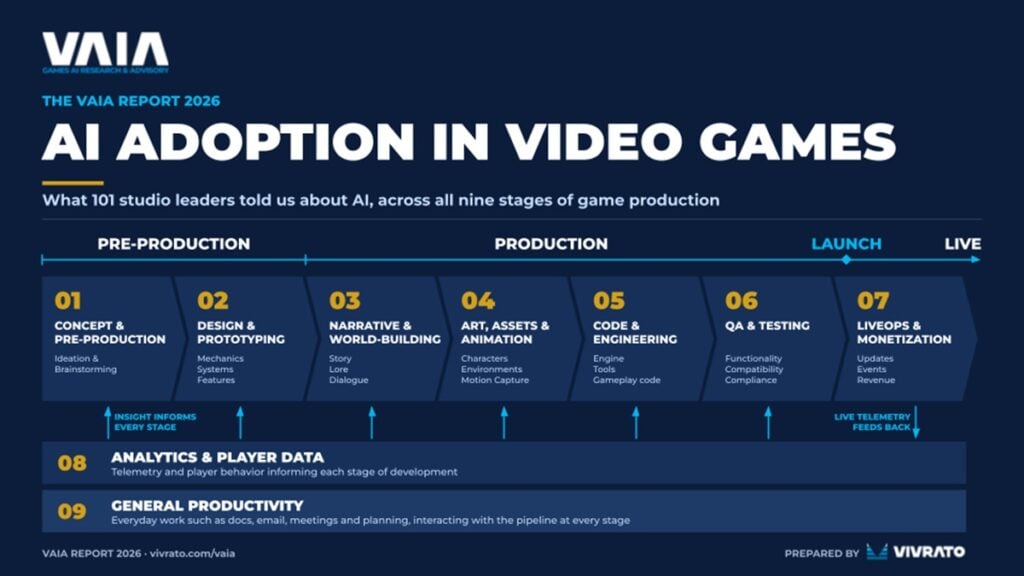

A new report offers a useful answer to a question that keeps getting flattened into an argument: how much AI are game studios actually using? Among 101 studio leaders interviewed by consultancy Vivrato, 94% reported AI use in at least one production stage. Yet 52% rated its integration across their production pipeline at three out of ten or lower.
Those figures sit quite comfortably together. A team can find a tool useful for a particular job without reorganising everything around it. That sounds less dramatic than a future where games manufacture themselves, but it gives developers and players something more concrete to discuss: which jobs are changing, and whether the change helps.
The Sample Matters as Much as the Percentage
VGC's October 20 coverage describes 101 confidential interviews conducted between April and September 2026, primarily with leaders at studios headquartered in North America and Europe. Each followed a 44-question guide covering nine production stages. The findings have received further coverage today.
That is a defined group of respondents, rather than a census of every game studio. It would be a mistake to turn the result into a claim that 94% of all developers worldwide use AI. These are also leaders describing their organisations, which gives us a different perspective from asking artists, programmers or QA staff about their own working days.
The distinction doesn't make the research unhelpful. Confidential conversations can make room for details that a public statement might leave out. They still produce reported experiences, rather than independently measured proof of what happened to a game's budget, quality or release date.
AI Covers More Than Generated Pictures and Dialogue
In GamesBeat's interview with Vivrato founder Adam Boyes, the research is described as covering six categories. These include generative AI, conventional machine learning, rules-based automation, models adapted to a studio's data, retrieval systems and agentic workflows. Across that broad definition, 97% of those interviewed said they had used AI in some form.
That breadth changes how we should read the headline. A system that helps predict player behaviour and a model generating character dialogue raise different questions. One might sit behind decisions about an update; the other might directly shape something the player hears. Lumping them together can hide exactly the detail an interested reader wants.
It also explains why a blanket declaration that a studio “uses AI” tells us so little. Ask what the system does, what information it works from and who checks the result, and the conversation becomes much more useful. A player concerned about generated artwork shouldn't have to guess whether an announcement about automation refers to artwork at all.
A Low Integration Score Can Describe a Sensible Choice
The three-out-of-ten figure is a self-assessment of integration depth. It isn't a review score for the tools, or a measurement of how much of a game they made. A low rating could reflect limited experiments, deliberate boundaries or work that remains confined to a small part of production. The rating alone doesn't tell us which explanation applies.
There is a perfectly reasonable version of adoption where a team finds two useful applications and stops there. If a tool saves time preparing internal documentation, that benefit doesn't need to be followed by generated dialogue or a new art pipeline. Expanding its role should depend on what the next task needs.
Equally, limited integration doesn't establish that AI has failed. Imagine a programmer getting a troublesome internal utility working sooner, then spending the recovered time improving the game. That would be a worthwhile outcome even if the rest of the studio changed very little. We'd want evidence that the time was saved, of course, but a narrow use can still be a valuable one.
The Useful Test Is What the Team Gets Back
Boyes told GamesBeat that his preferred approach includes measuring results, retaining human involvement and discussing the tools openly with teams and players. That is a more practical starting point than treating the number of AI-enabled tasks as an achievement on its own.
For developers, the worthwhile comparison includes the time spent checking and repairing output. Something that arrives quickly but takes longer to make usable hasn't necessarily helped. Something modest that reliably removes a tedious step might make a real difference. Counting both as adoption is fair enough for a study; assessing their value requires looking closer.
That is why this report makes an interesting companion to the reported AI-first instructions on Epic's Disney project. A broad production mandate and a team selectively adding tools represent quite different approaches. Neither can be judged simply by confirming that AI is present.
For players, clearer descriptions would help too. Tell us what changed and how it affects the work we'll encounter. The most convincing evidence will be a better game, a useful improvement or a well-supported explanation of the process. A large adoption percentage is a reason to investigate those outcomes, rather than assume they've already arrived.
Sourcing note: this article draws on VGC's reporting and GamesBeat's October 20 interview with Adam Boyes. The figures are reported findings from Vivrato's interview study; we haven't independently audited the studios or reviewed the full research dataset. Featured graphic: Vivrato, via GamesBeat.
Would you rather hear that a studio has adopted AI widely, or see a specific example of where it helped the game? Let us know your thoughts in the comments. And if you've got a game you'd like us to review, send it over to editor@gamevibe.io.